
Researcher Mode Digital Artefact – BCM206 Future Networks
Research question: What language features in recommendation-request posts on r/HistoricalRomance are associated with higher levels of community response?
Research Introduction
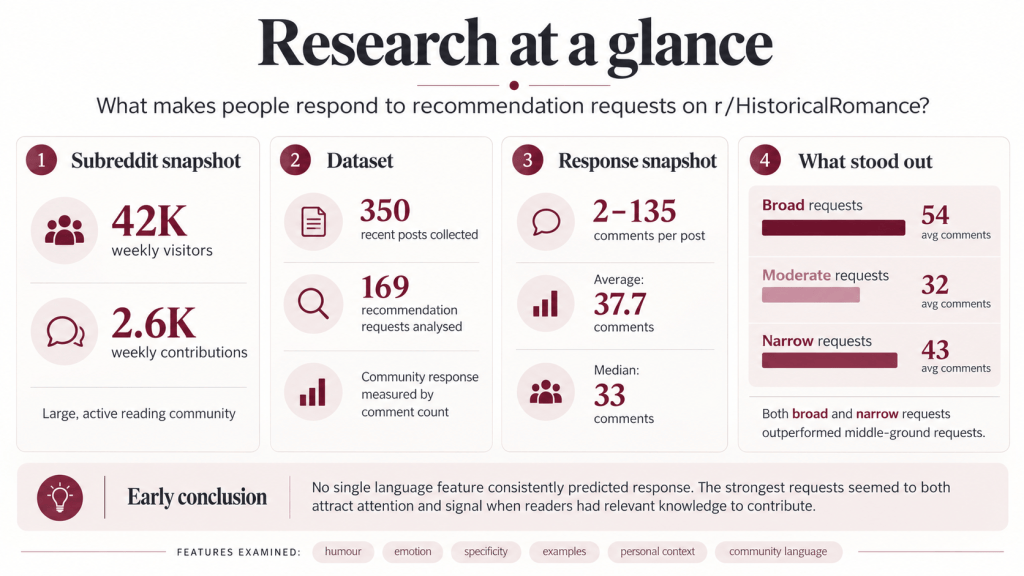
I’ve used r/HistoricalRomance for more than two years and rely on it heavily for book recommendations. With around 42,000 weekly visitors and 2,600 weekly contributions (Reddit, n.d.), it is also a highly active and, in my experience, supportive community. Over time, I realised that some requests attracted dozens of replies while others received very little response, even when they seemed similar. I therefore asked: What language features in recommendation-request posts on r/HistoricalRomance are associated with higher levels of community response? I found that no single language feature consistently predicted the level of response. Instead, successful requests seemed to attract attention while also signalling that users had relevant knowledge to contribute.
Research Development
Cycle 1: Testing my original assumption
Action: I started with a pilot sample of ten recent recommendation requests: five with relatively high response counts and five with relatively low counts. My initial assumption was that funny, emotive or distinctive language would attract more engagement because these posts seemed more noticeable. Goldhaber’s (1997) concept of the attention economy helped frame this idea. He argues that while information is abundant in networked environments, human attention is limited. On Reddit, users therefore have to choose which posts they stop, read and respond to.
Reflection: The pilot only partly supported this. The highest-response post used a funny and expressive title and received 139 comments, but another short and unemotional request received 94. Some highly detailed posts received very little response. Attention-grabbing language clearly could not explain the differences on its own.
Adaptation: I expanded my coding to include title style, humour, emotion, specificity, examples, personal context, direct community language and how easy the request seemed to answer. This helped move the project beyond just asking whether “engaging” language performed better.
| Example from pilot | Comments | Why it stood out |
|---|---|---|
| “Forgive me lords and ladies, but I must sin” | 139 | Funny, highly emotive and distinctive — strongly supported my original attention hypothesis. |
| “Books which talk about/mention the FMC having her period” | 94 | Relatively straightforward and unemotional, yet still received very high response. |
| “religious romance with strong guilt, desire, imagery in prose, and blasphemy…” | 81 | Very niche and detailed, with strong descriptive language and examples. |
| “MC is jealous of the other MC” | 3 | Long and detailed with several examples, but received almost no response. |
Cycle 2: Expanding the dataset
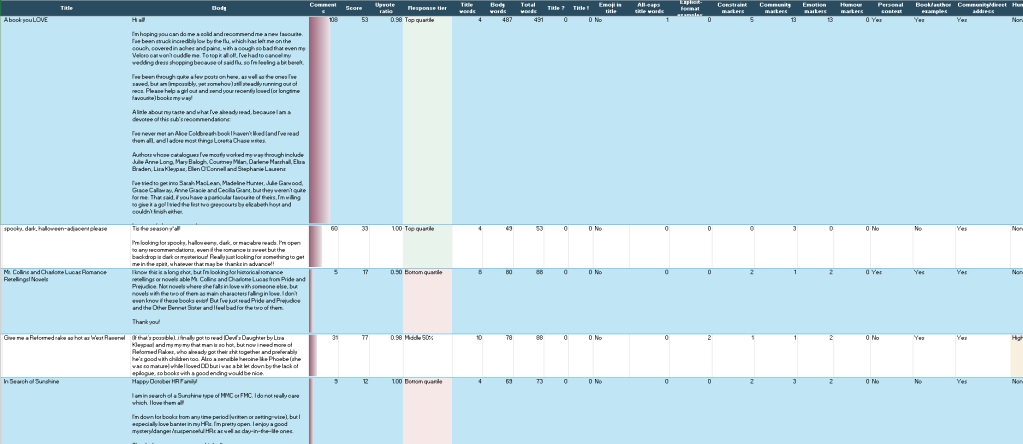
Action: I used an Apify Reddit scraper to collect 350 recent posts from r/HistoricalRomance, including titles, body text, comment counts, scores and other basic metadata. After filtering, I had 169 eligible recommendation requests. I used GenAI to help with coding before manually checking samples from each category and correcting any errors.
Reflection: The larger dataset weakened my original assumption further. Witty and attention-grabbing posts sometimes performed well, but these features were not consistent enough to explain response levels on their own. Highly specific requests and posts with more conditions were also not penalised in the way I expected and, in the averages, often received more responses. Zhao et al. (2021) similarly found that question characteristics can affect response outcomes, while emotional language had little effect. This matched what I found: being expressive might help sometimes, but it was not enough to explain the responses.
Adaptation: I stopped looking for one “best” writing style and instead focused on what might help users recognise that they could contribute a useful answer.
| Feature coded | What I looked for |
|---|---|
| Title style | How attention-grabbing or distinctive the title was. |
| Humour | Witty, playful or joking language. |
| Emotion | Emotional or expressive wording. |
| Specificity | How clearly defined the desired recommendation was. |
| Book/author examples | Whether books or authors were provided as reference points. |
| Personal context | Whether the poster explained their own situation, preferences or reason for wanting the recommendation. |
| Community language | Whether the poster directly addressed or interacted with the subreddit community. |
| Ease of answering | How straightforward it seemed for another user to identify and suggest something relevant. |
Cycle 3: Looking at the bigger picture
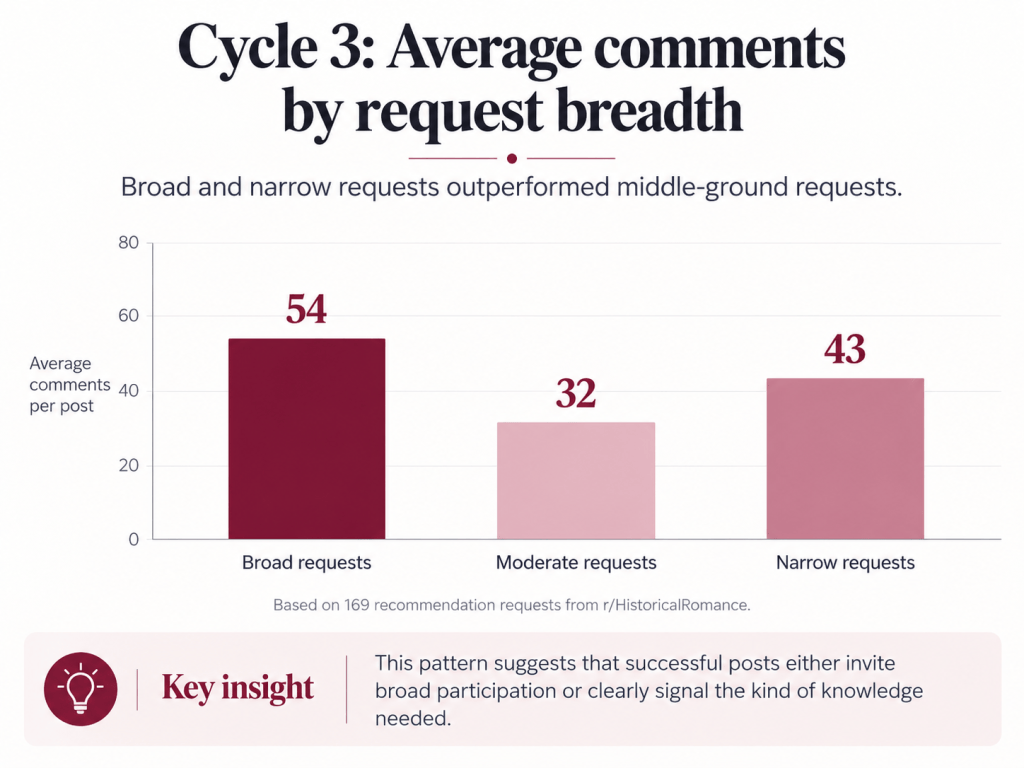
Action: Comparing the coded categories showed that both broad and narrow requests tended to receive more responses than middle-ground requests. Broad requests averaged about 54 comments and narrow requests about 43, compared with around 32 for moderate requests.
Reflection: This changed how I understood the results. Broad requests give many people something they could contribute, although I know from my own behaviour that very broad questions can sometimes feel too open-ended. Specific requests can instead create that immediate “I know just the thing” moment. Jin et al. (2013) found that people are more likely to continue sharing knowledge online when they feel confident that what they know is useful.
Castells’ network society helped me see r/HistoricalRomance as a decentralised network where knowledge is spread across readers rather than held by one central source. A recommendation request sends an information need into that network, and its wording can help users recognise when their own knowledge is relevant. However, the network is not neutral. Massanari (2017) shows that Reddit’s design and ranking systems also influence what becomes visible and how users participate.
Adaptation: My final view became that there is no single “best” way to write a recommendation request. Successful posts seem to either make participation easy for many people or clearly signal the kind of knowledge needed so the right people recognise that they can help.
Key Takeaways
My research began with Goldhaber’s (1997) attention economy, which helped explain why recommendation requests compete for users’ limited attention. However, the dataset showed that attention alone did not consistently translate into response. Castells’ network society offered a broader explanation: r/HistoricalRomance is a decentralised network where readers hold different kinds of knowledge, and language can help connect a request with people who recognise that their knowledge is useful. This changed my understanding of successful recommendation requests. Rather than there being one “best” writing style, higher-response posts seem to make participation accessible or clearly signal who may have something relevant to contribute. By this logic, language doesn’t just capture attention; it helps turn attention into participation.
Reference List
Castells, M 1996, The rise of the network society, Blackwell, Oxford.
Goldhaber, MH 1997, ‘The attention economy and the net’, First Monday, vol. 2, no. 4.
Jin, X-L, Zhou, Z, Lee, MKO & Cheung, CMK 2013, ‘Why users keep answering questions in online question answering communities: A theoretical and empirical investigation’, International Journal of Information Management, vol. 33, no. 1, pp. 93–104.
Massanari, A 2017, ‘#Gamergate and the fappening: How Reddit’s algorithm, governance, and culture support toxic technocultures’, New Media & Society, vol. 19, no. 3, pp. 329–346.
Reddit n.d., r/HistoricalRomance, Reddit, viewed 17 October 2026, https://www.reddit.com/r/HistoricalRomance/
Zhao, Y, Wu, L, Zhang, J & Le, T 2021, ‘How question characteristics impact answer outcomes on social question-and-answer websites’, Journal of Global Information Management, vol. 29, no. 6, pp. 1–21.
AI Acknowledgement
Generative AI was used to assist with developing the coding framework, coding and checking the Reddit dataset, identifying patterns in the data, and refining the presentation of this research. I manually reviewed samples across each coding category, corrected identified errors, and based the final analysis on the checked dataset. Generative AI was also used to assist with editing written content and developing supporting visuals for the final research dossier.





Leave a Reply