
The Game:
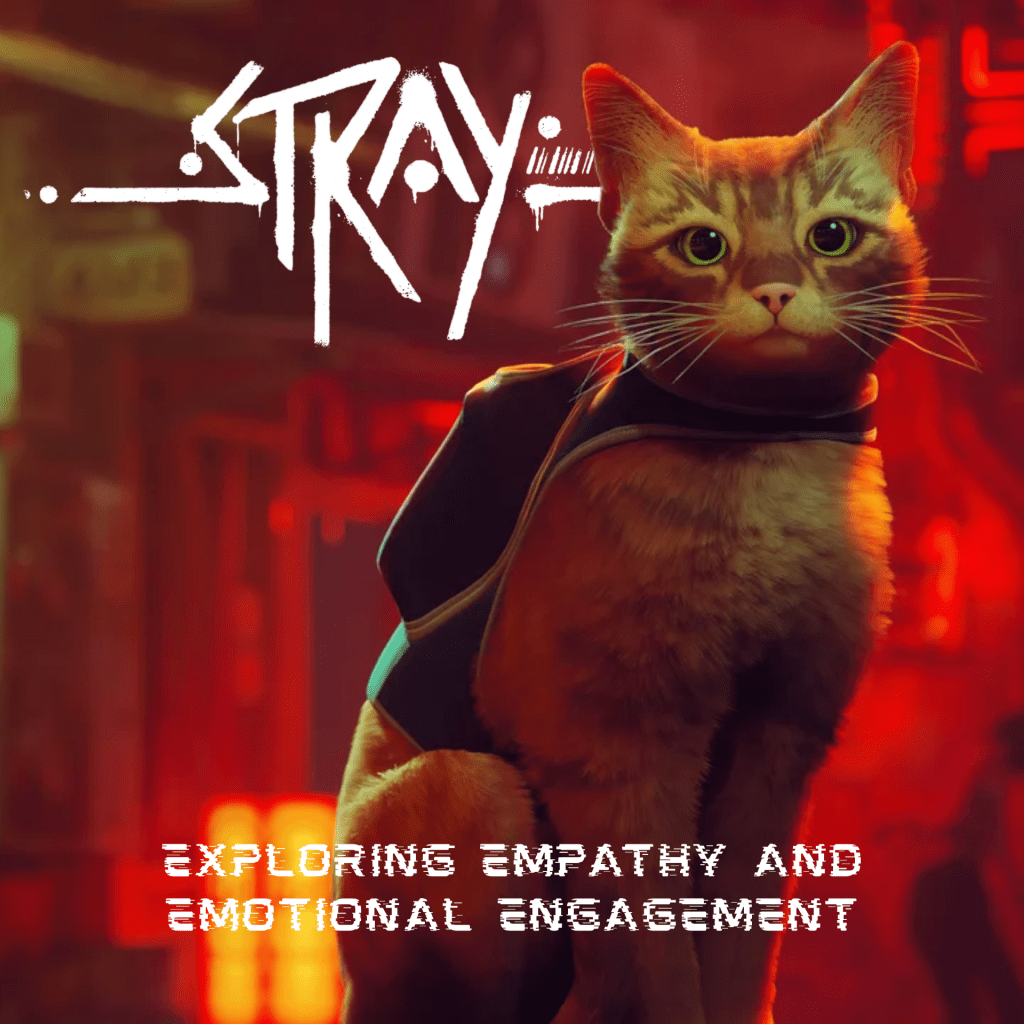
The video game Stray (BlueTwelve Studio 2022) is a third-person adventure RPG primarily set in a post-apocalyptic, neon cybercity inhabited only by robots. The game begins when a mischievous orange cat accidentally becomes separated from its family, falling tragically into the bowels of an underground cybercity. With the help of a few humanoid robots, players must control the stray cat to navigate through the neon-lit environment and reunite it with its family. This emotionally compelling game is characterised by its environmental storytelling, exploration and puzzle-solving, and offers insightful commentary on technology, companionship and what it means to be human in a world where there aren’t any humans left.
The idea of players forming emotional attachments to a game and experiencing empathy for non-human characters led me to explore the question: Why is Stray so emotionally compelling to players despite its lack of human characters? This analysis uses a psychoanalytical framework informed by attachment theory, empathy studies, and media psychology to examine the emotional depth of player–character relationships within the game.
The Analytical Framework:
Bowlby’s (1969) attachment theory provides the basis of psychoanalysis, arguing that people form attachments with others gradually throughout their lives. People tend to look to attachment figures – whether it’s family, friends, or even pets – to seek comfort and security in times of stress. Isbister’s (2016) research on empathy in games supports this understanding, explaining how interactive design, character responsiveness, and narrative structure can elicit empathy and emotional engagement in players.
As Johanssen (2024) explains, psychoanalysis offers valuable insight into the unconscious desires behind creative expression, which allows for a deeper exploration of the creator’s intentions and character motivations, making it particularly effective in analysing Stray and the audience’s reaction to it. Complementary to this, Shoshani, Braverman and Meirow (2021) discuss how advancements in gaming technology have expanded the emotional and narrative complexity of digital experiences, fostering stronger affective connections between players and non-human characters.
Broader research also suggests that storytelling can influence psychological and physiological responses, increasing positive emotions while reducing pain and cortisol levels (Brockington, Smith and Lee 2021). In addition, the concept of Kama Muta, an emotional response characterised by feelings of warmth, closeness or unity when encountering something perceived as cute, is frequently triggered by stimuli that evoke tenderness, vulnerability or nostalgia (Lieber-Milo 2025; Steinnes 2017). Stray’s use of a cat protagonist, an animal globally recognised as “cute”, provides a compelling context for understanding why players develop emotional attachment and experience positive emotions towards the character throughout the narrative.
Through the combination of these views, the psychoanalytical framework positions Stray as an interactive text that invites emotional projection and empathetic engagement, illustrating how attachment and empathy operate even in the absence of human representation.
The Analytical Framework in Practice:
An interesting example of the psychoanalytical framework in practice occurs in the prologue of Stray, where the protagonist cat follows its family along the outer walls of the underground cybercity. During this sequence, a pipe beneath the cat breaks and begins to fall. Our protagonist cat is unable to escape before it snaps, resulting in them plummeting into darkness. This emotionally intense scene is heightened through cinematic techniques such as tense music, camera angles, and lighting, which combine with gameplay design to elicit empathy.
Player attachment to the protagonist is reinforced from the start of the game by the inclusion of non-essential, endearing actions, such as drinking from puddles, cozying up with other cats, or taking a nap. These interactions, while not essential to gameplay, encourage emotional investment and align with Isbister’s (2016) research, which highlights that interactive and responsive character behaviour fosters empathy in players. The use of motion capture to replicate realistic feline movements further improves the character’s lifelike quality, supporting Shoshani, Braverman and Meirow’s (2021) argument that technological advancements increase narrative and emotional complexity in games. While it’s not impossible to become emotionally attached to video game characters that are old, low-quality or even 2D, I think the nature of the protagonist’s character model, being so realistic in its shape and movement, serves the game incredibly well.
Additionally, the protagonist’s perceived cuteness engages the emotional response described by Kama Muta, which is triggered by stimuli that evoke tenderness, vulnerability or warmth (Lieber-Milo 2025; Steinnes 2017). The combination of character design, interactivity, and narrative tension cultivates a sense of attachment that conforms with Bowlby’s (1969) attachment theory, making the prologue scene particularly effective and emotionally resonant for players.
The Digital Artefact:
My digital artefact will take the form of a series of YouTube Shorts, with each short focusing on a different scene or moment from Stray. The first video will aim to explore the prologue, as mentioned above, where the cat falls and becomes separated from its family, while later videos will cover moments such as the cat meeting its robot companion, the robots showing affection or human-like behaviour, and the ending where the cat returns to the outside world and its reunion with its family is left uncertain.
This format works well because psychoanalytical concepts can be quite wordy or overwhelming for viewers unfamiliar with them. Presenting the analysis in short, engaging videos makes the content easier to follow and more visually interesting. YouTube is also the most suitable platform, as it has a huge gaming community and is already used by creators who play and analyse video games. Breaking the analysis down into bite-sized pieces will make the theory more approachable while still reaching the right audience.
The Conclusion:
In conclusion, the psychoanalytical framework gives us a way to understand why Stray evokes such strong emotional responses from players despite its absence of human characters. By combining Bowlby’s (1969) attachment theory, Isbister’s (2016) work on empathy, and further studies on technological immersion and emotional responses, psychoanalysis demonstrates how interactivity, realism, and certain design elements can elicit deep attachment to characters – even those that are non-human. My proposed digital artefact will further demonstrate these findings through accessible, visually engaging short-form content, which allows the gaming community to listen to academic theory that explains their player experience and highlights Stray’s unique emotional and psychological impact.
References
BlueTwelve Studio 2022, Stray , Annapurna Interactive.
Bowlby, J 1969, ‘Attachment and Loss, Volume I: Attachment’, The British Journal of Sociology, vol. 21, no. 1, pp. 194–202.
Brockington, G, Moreira, APG, Buso, MS, Silva, SG da, Altszyler, E, Fischer, R & Moll, J 2021, ‘Storytelling Increases Oxytocin and Positive Emotions and Decreases Cortisol and Pain in Hospitalized Children’, Proceedings of the National Academy of Sciences, vol. 118, no. 22.
Isbister, K 2016, How Games Move Us, MIT Press.
Johanssen, J 2024, ‘Media Use and Psychoanalysis: Theoretical and Empirical Perspectives’, vol. 1, Springer Nature, pp. 105–121.
Lieber-Milo, S 2025, ‘Cuteness and Its Emotional Responses’, Encyclopedia, vol. 5, MDPI AG, no. 3, p. 146.
Shoshani, A, Braverman, S & Meirow, G 2021, ‘Video Games and Close relations: Attachment and Empathy as Predictors of children’s and adolescents’ Video Game Social Play and socio-emotional Functioning’, Computers in Human Behavior, vol. 114.
Steinnes, KK 2017, ‘Too Cute for Words: Cuteness Evokes the Kama Muta Emotion and Motivates Communal Sharing’, Frontiers in Psychology, vol. 10, no. 387.




 Lazy Pages
Leave a comment