

Jasmin’s DA centres around curating content on sustainability and promoting topics that are relevant and/or interesting to a Gen Z audience. Through interacting with sustainability accounts on Instagram, Jasmin aims to utilise existing sustainability networks to increase the reach of this information to her audience.
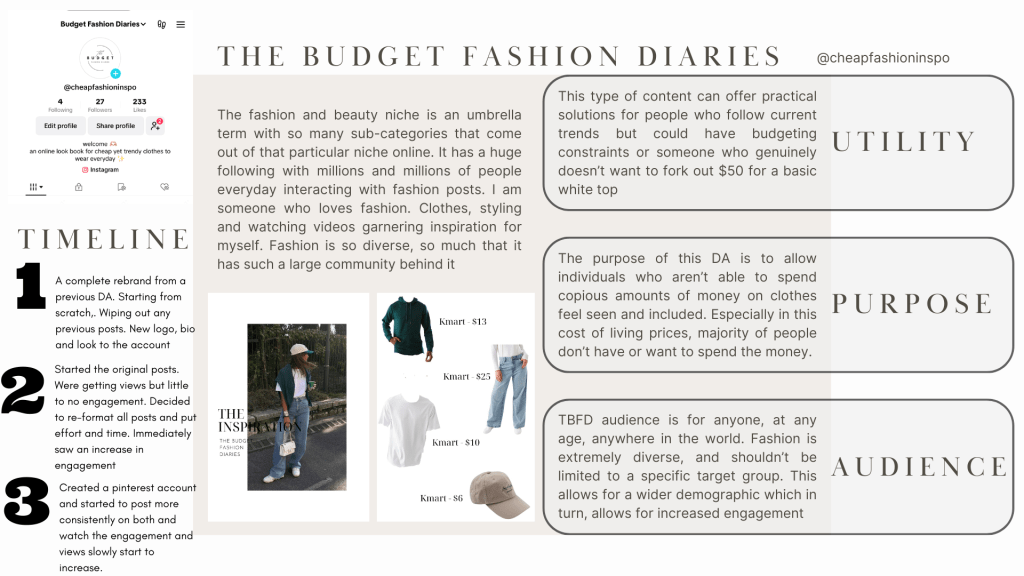
Piper’s DA ‘The Budget Fashion Diaries’ focusses around finding cheaper fashion alternatives for trending outfit inspiration on Pinterest for any woman or male of any age. There are no restrictions as fashion is extremely diverse. Through the use of TikTok and now Pinterest, Piper aims to reach a wider audience that doesn’t target a specific demographic.
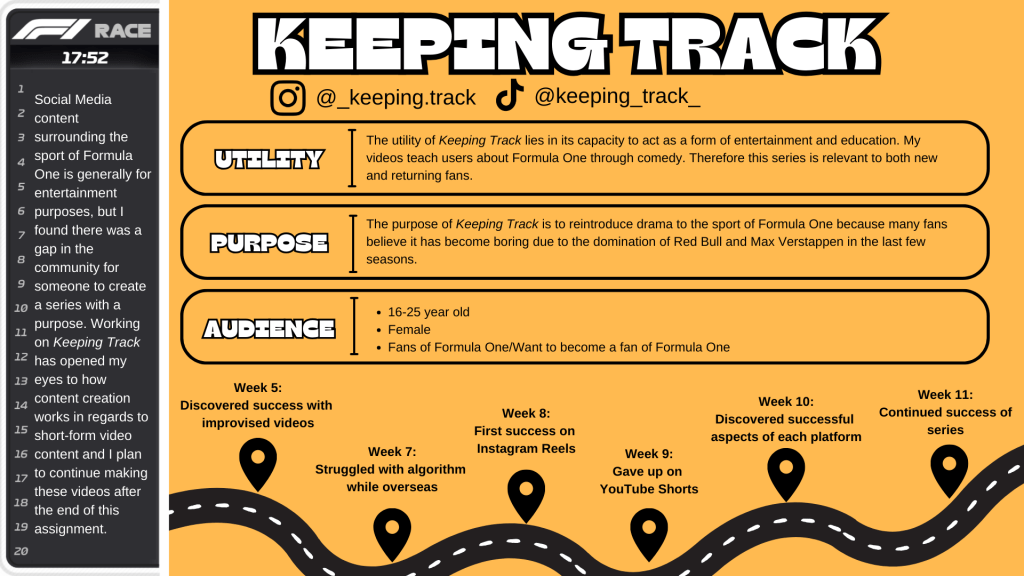
Taylah’s DA focuses on drama and key moments surrounding midfield teams and drivers in Formula One with the aim of reintroducing excitement into the sport after the domination of Red Bull and Max Verstappen for the last two years. Her target audience is existing fans who have lost interest in the sport, especially female fans.
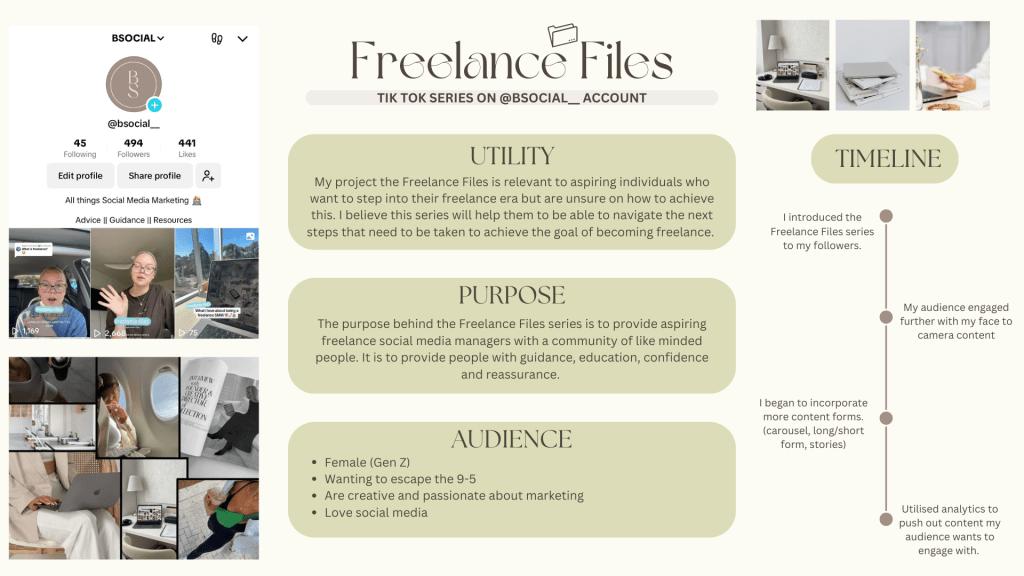
Lara created the Freelance Files to be a series on her TikTok account @bsocial___. Lara created this series to be targeted towards people who are wanting to step into their freelance era and escape the 9-5. The series “Freelance Files” covers all things about becoming freelance, how to gain the confidence to work as a freelancer, providing you guidance and reassurance on what freelance life is all about. Here is the link to her project pitch.

Operating as @leukwhoisliving, Ruby’s DA is centred around sharing diverse cancer experiences, fostering a supportive community for those on similar journeys. Throughout BCM112 Ruby has expanded her page to share content that addresses the challenges of hospital life through informative reels. With the aim of fostering empathy and connection Ruby’s aim to reach a larger audience is based on the objective to help more people experiencing a similar journey.
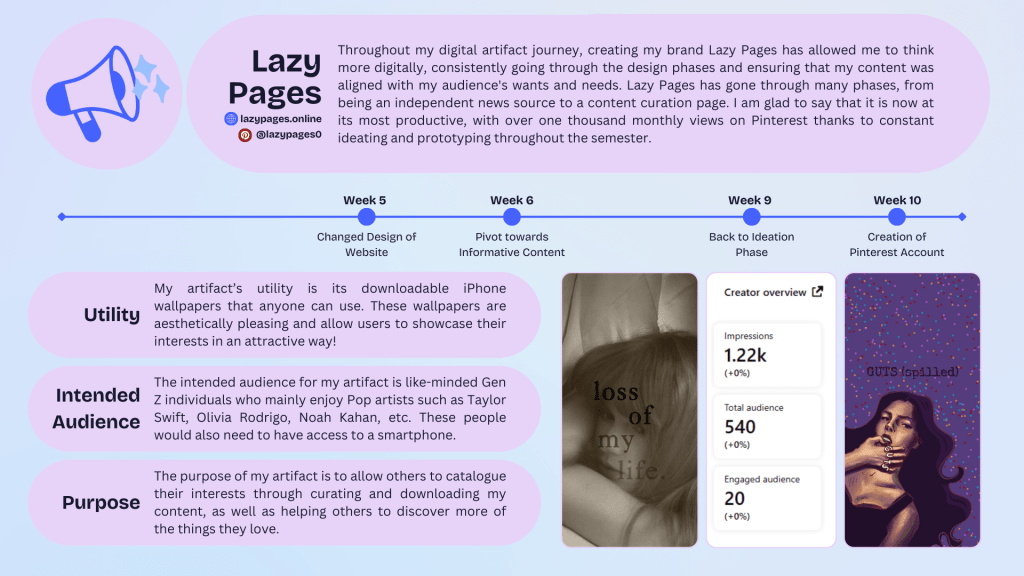
Cassie’s Digital Artefact is her Pinterest page Lazy Pages which shares and curates aesthetic content and downloadable iphone wallpapers for her favourite music artists. Over the course of this subject, the content for Cassie’s brand, Lazy Pages, has changed however the aim is still the same: to attract traffic to the site and cultivate a community of like-minded subscribers.

Savannah’s digital artefact is an Instagram account that promotes her small business, Two Sisters Templates, which sells customisable event stationery templates for special occasions such as weddings. It aims to engage a larger number of her target audience in time-poor individuals planning events, to attract more sales and extend the Etsy store’s reach.

Ella, known as @imjustagirl, runs “I’m Just a Girl,” an Instagram platform delving into internet-driven girlhood trends like ‘girldinner’ and ‘girlmath’ and contextualising them within broader societal themes. Here, She delves into the intricate layers of contemporary girlhood, using trending content and shared experiences as a guide to navigate the ever-changing digital landscape.
Our network group chat was formed via Instagram direct message. The purpose of this group chat creation was to ensure that we had access to each other’s content in one spot, regardless of individual DA platforms. Reflecting on the formation of our network group channel, it’s clear our Instagram group chat and the communication we utilise is a tool that fosters Collective Intelligence within our network and it was recognised by all members of the network. The back and forth communication allows for fast feedback loops (Wall 2024), and the effective mobilisation of skills. This element of collective intelligence allows for each member’s skills and experiences to be beneficial to everyone in our network.
The next step was to ensure we all had the ability to consistently engage with one another’s content. This led us to start utilising Instagram’s favourites filter which chronologically shows the latest from accounts that you’ve favourited. Engaging with each other’s content is a key moment for our network to boost engagement and create a community of encouragement. Social media algorithms often prioritise content with higher engagement, so by liking, sharing, and commenting on each other’s posts, we amplify visibility. Upon reflection, it became evident that utilising the favourites filter not only helped us stay up to date with each other’s posts but it also fostered timely interactions.
Seeing the variety of ways that individual artefacts were succeeding, we collectively agreed to share our tips for success, aiming to enable everyone to maximise the success of our artefacts. After sending our advice to the group chat, we compiled the tips into a list of methods that became our ‘Secret Formula’ for content creation. From this we created a distributed web of knowledge and gained more insight into how each other approached our artefacts, allowing us to make more informed and researched decisions when creating content. We then went on to consult each other’s tips for success when posting online, especially when trying to navigate through the complex algorithms on TikTok and Instagram.

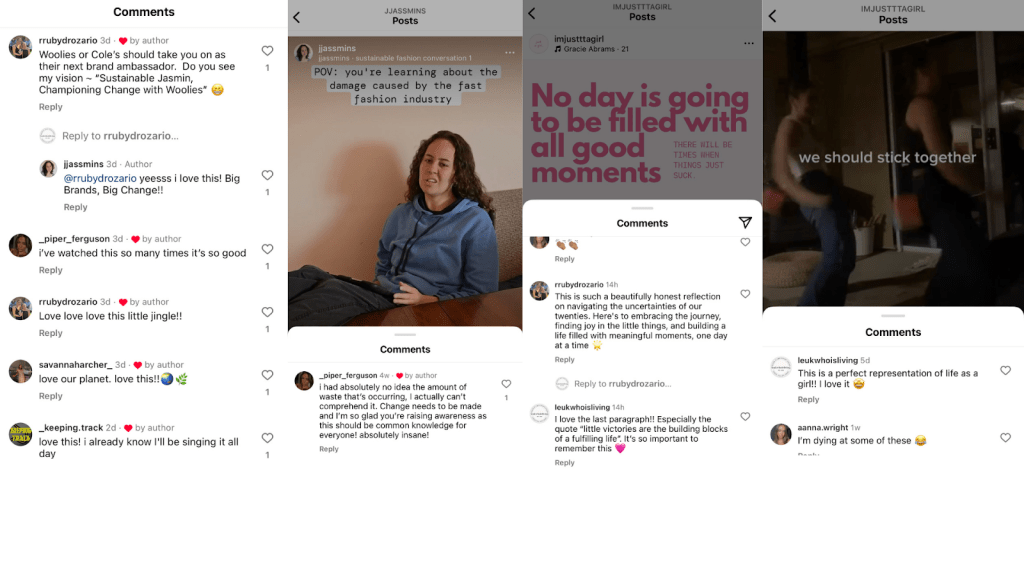
In our network, we leveraged algorithms, data, and participatory culture to enhance our digital presence. One effective method was the use of “engagement pods.” This strategy, initially popularised by Instagram influencers when the platform moved to algorithmic recommendations, involves a collective effort to interact with each other’s content. By utilising the dialogic nature of Instagram, engagement pods trick the algorithm into perceiving content as more viral than it actually is, thus boosting visibility and reach (O’Meara, 2019). Taylah introduced this tactic from her previous network, aiming to expand our engagement pod’s reach. Consequently, all our digital artefacts experienced a significant increase in overall engagement, evidenced by mutual interactions across our network.
This method is deeply intertwined with collective intelligence. By sharing our successes and failures in a group chat, we refined our content strategies much faster than working individually. This collaborative sharing of expertise highlighted key areas to focus on or avoid in our content creation efforts (Gustavo, 2017). The pooling of knowledge generated a sense of direction and support among our projects, offering tried and tested methods and approaches throughout the design thinking process. Our collective approach fostered a supportive and efficient environment, enhancing the productivity and effectiveness of our network.
Integrating algorithms, data, and participatory culture through engagement pods and collective intelligence not only amplified our digital engagement but also streamlined our content creation process, making our network more resilient and adaptive.
References:
- Gustavo 2017, “Collective Intelligence and Swarms in the Red Insurgency”, viewed 20 May 2024, <https://medium.com/rally-point-journal/collective-intellignce-and-swarms-in-the-red-church-49f6a6d04825>
- O’Meara, V 2019, ‘Weapons of the Chic: Instagram Influencer Engagement Pods as Practices of Resistance to Instagram Platform Labor’, Social Media + Society, vol. 5, no. 4, viewed 15 April 2024, <https://journals.sagepub.com/doi/full/10.1177/2056305119879671>.
- Wall, T 2024, Algorithms and Data, vodcast, 4 April, viewed 27 May, 2024 <https://youtu.be/bbWyJ0QjKXY?si=5JeFM82klHBpeMvW>
- Wall, T 2024, Collective Intelligence, vodcast, 22 March, viewed 27 May, 2024 <https://www.youtube.com/watch?v=0t4bvHCtECk&t=193s>.
- Wall, T 2024, Participatory Culture, vodcast, 15 March, viewed 27 May, 2024 <https://youtu.be/CwA0o6snnQQ?si=fKCH2qIqP1TDNSHs>

 Lazy Pages
Leave a comment