
Our network consists of four digital artifacts produced by Cassie, Piper, Jasmin and Savannah. Cassie’s design of Lazy Pages, a news website and accompanying Instagram page targeting Gen Z, focuses on creating visually appealing content alongside curated news articles. The website hosts longer articles, while the Instagram page features shorter, engaging images and videos. This strategy aims to attract traffic to the site and cultivate a community of like-minded subscribers. Jasmin’s sustainability education starter aims to increase the ease of access to a wide range of sustainability information through the curation of content across platforms. The initial plan was to create posters that summarise information from a variety of sources, however this shifted to short-form videos using the logic of digital production. Developed by Savannah, Two Sisters Templates is an Instagram account that promotes her small business which sells customisable templates for special events such as weddings. It aims to attract sales through greater exposure and engagement with her account, reaching more of her target audience- time-poor individuals planning events. We will analyse the impact of our collaboration using the collective intelligence phenomenon.
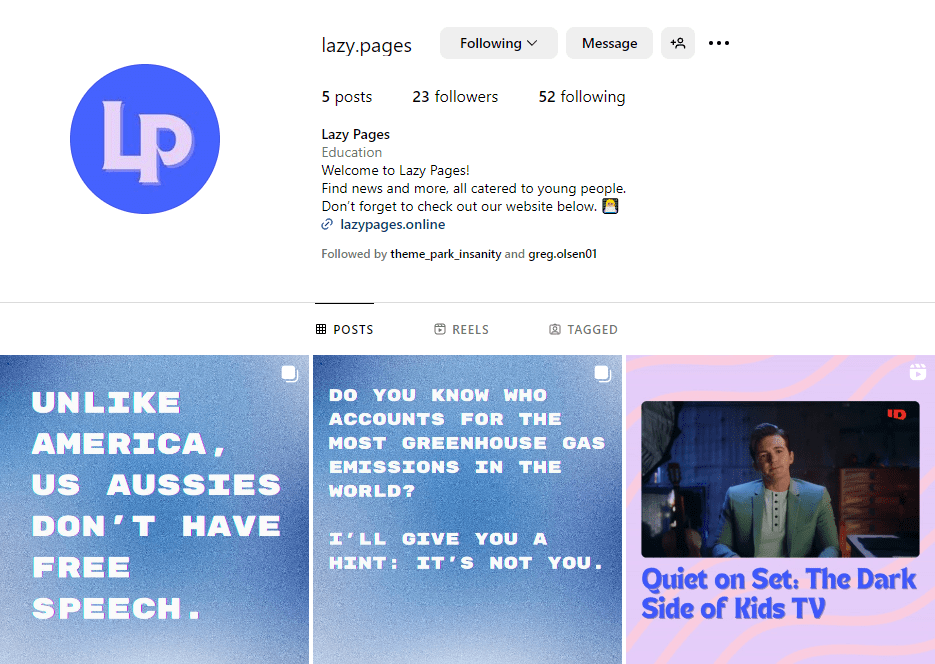
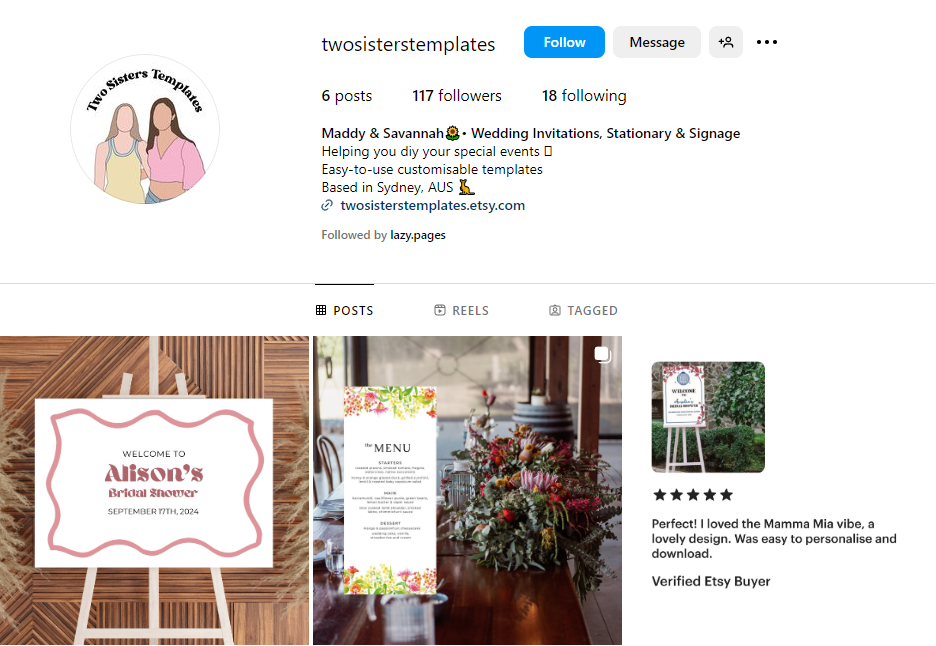
A significant problem encountered by two group participants, Cassie and Savannah, was the overly broad and time-consuming nature of our artifacts. Facing an unsustainable artifact we explored ways to reduce the workload. Deciding to take different approaches, Cassie chose to break and remake her current prototype by using LLMs to generate article content and proceeding to testing, while Savannah abandoned her idea and began the design process afresh, starting a completely new artifact that followed through ideation into prototyping and testing; wherein Plattner’s (2010) design thinking process is evident. From this, we gained more experience in artifact prototyping, becoming more mindful of our constraints, such as time, and the importance of refining and narrowing down ideas before prototyping.
Furthermore, the whole group faced issues getting views without engagement, and brainstormed strategies to boost interaction. Discovering the algorithm’s preference for frequent posting, we realised the importance of consistent content delivery. Informed by this insight, we committed to posting on a regular schedule to stimulate engagement. We aimed to create accountability for ourselves by setting each other reminders to ensure everyone adheres to their schedule, fostering a supportive environment for sustained collaboration and growth. Additional tips included using three main hashtags (broad topic, reel specific, niche related) were also trialed in our projects, and are still undergoing analysis.
Another problem faced by our networking group was uncertainty surrounding Instagram and how to promote content and gain followers. After seeking feedback from the group for the Lazy Pages Instagram page, Savannah provided great feedback on utilising Instagram reels, which have a broader reach compared to regular posts and can engage viewers beyond current followers. Using this information, Cassie decided to do more research into current music and social media trends to start creating reels – incorporating Savannah’s advice to engage a wider audience. Informed by this information, our group continued to support each other’s content by providing feedback and sharing our insights to refine our approaches to content creation.

The collective intelligence phenomenon has been evident within our peer collaboration process through the development of our artifacts. This can be seen in our combination of knowledge that allowed us a greater understanding of Instagram algorithms. The effective mobilisation of skills towards a common goal (Sassi et al. 2022) is another key element of collective intelligence that we found ourselves experiencing, in our real-time sharing of expertise on areas of gaining engagement, such as through reels. Ubiquitous connectivity provided by the internet empowered us to instantaneously engage with and contribute to one another’s digital artifacts, which fostered more sophisticated content creation. As Sassi et al. (2022) highlights, collective intelligence can give way to more innovative responses than work done individually. Moreover, peer collaboration meant we could provide each other with constant feedback on the effectiveness of our content, and has refined our ideas for a more skillful content loop (Wall 2024).
Despite producing dissimilar content, an emergence of aligned direction can nonetheless be seen, as the direction and intention of our content all eventuated towards increasing viewer engagement and reaching a larger audience. The collective intelligence phenomenon demonstrates that collaboration becomes ingrained in ideation and prototyping processes, becoming highly valuable as it introduces new and more varied perspectives and skills that would otherwise be inaccessible as individuals.
References
Cross, M 2014, Social Media Security, Syngress, pp. 21–43.
Plattner, H 2010, Introduction to Design Thinking, Institute of Design at Stanford, viewed 13 April 2024, <https://web.stanford.edu/~mshanks/MichaelShanks/files/509554.pdf>.
Sassi, S, Ivanovic, M, Chbeir, R, Prasath, R & Manolopoulos, Y 2022, ‘Collective intelligence and knowledge exploration: an introduction’, International Journal of Data Science and Analytics, vol. 14, no. 2, pp. 99–111.
Wall, T 2024, Collective Intelligence, online video, 22 March, YouTube, viewed 23 April 2024, <https://www.youtube.com/watch?v=0t4bvHCtECk>.




 Lazy Pages
Leave a comment