
My project, Lazy Pages, is aimed at providing visually appealing news content for Gen Z. Through iterative design thinking phases, I addressed website redesign, content creation strategies, and platform selection. I analyzed these processes through the lens of collective intelligence, exploring how user contributions shaped the project’s evolution.
Using Plattner’s (2010) design thinking process during the project, I empathised with my audience’s need for visually appealing and easily digestible news content. However, upon reflection, I realised that the design of my website did not align with this vision. This led me to define the problem: the colour scheme and structure needed adjustment and my original plan to write full articles periodically was impractical given time constraints.
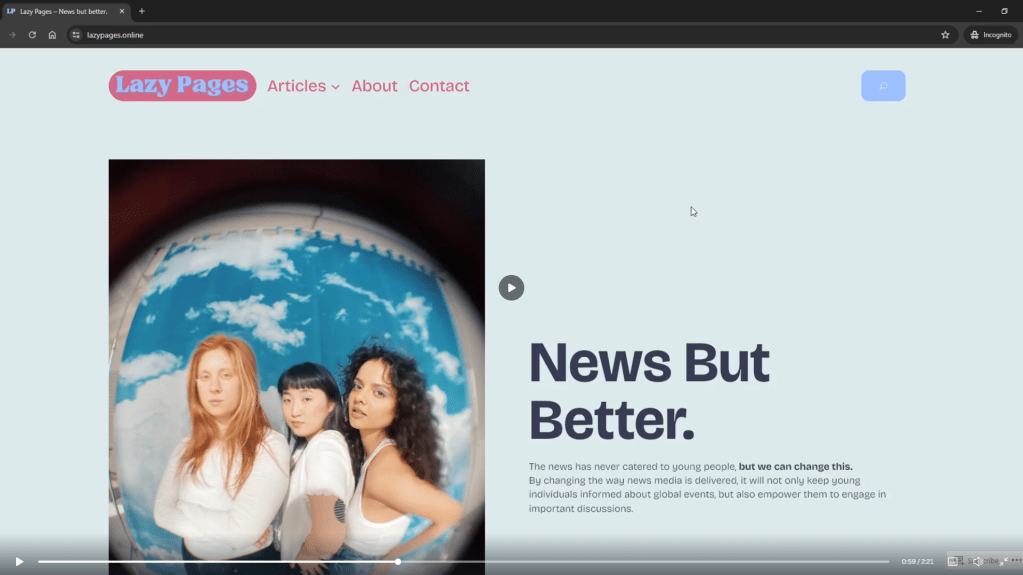
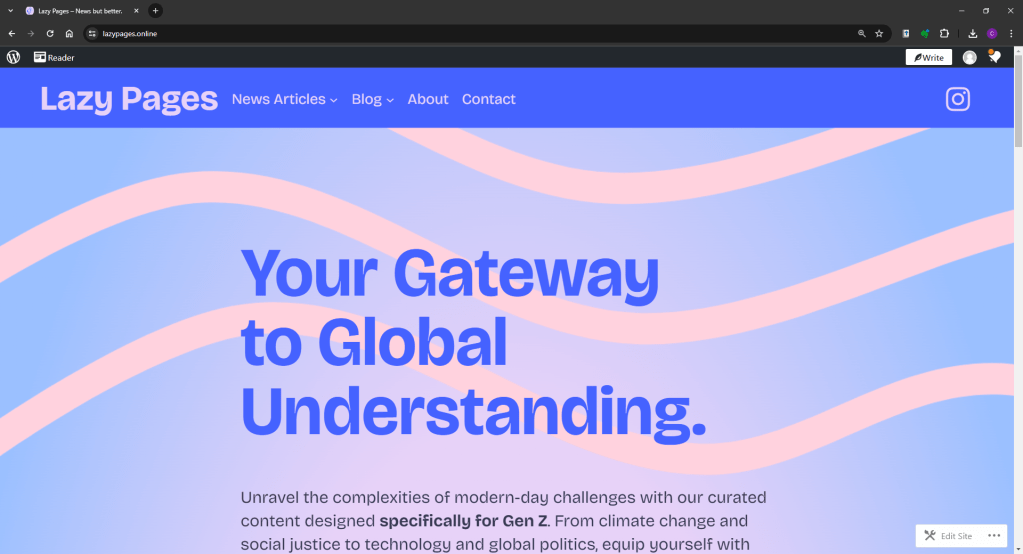
To address these issues, I embarked on a redesign process, ideating potential solutions to improve the website’s aesthetics and functionality. Additionally, I experimented with incorporating ChatGPT/LLM to streamline content creation, prototyping this approach to see how it would enhance efficiency.
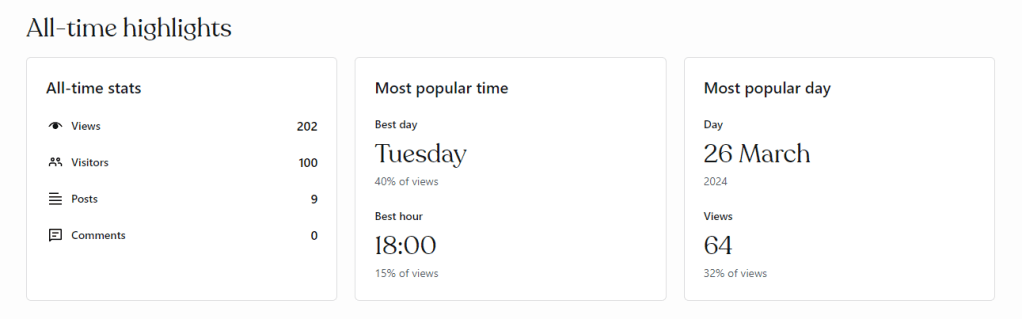
Consulting a networking partner for advice on low Instagram engagement marked another testing phase of the design thinking process. Their insights prompted me to reassess my approach and use Instagram Reels, emphasizing the importance of external perspectives in problem-solving. This experience reinforced the need to seek guidance and leverage external resources. Despite difficulties on Instagram, I observed an increase in website traffic with the addition of new articles, indicating the effectiveness of the content. This led me to contemplate exploring TikTok as an alternative platform, but ultimately, I decided to double down on Instagram due to its format’s suitability for promoting website content.
Overall, these iterations taught me valuable lessons in flexibility, persistence, and strategic decision-making, reflecting the iterative nature of the design thinking process. By empathising with my audience, defining the problem, ideating potential solutions, prototyping approaches, and testing their effectiveness, I was able to refine my approach to content creation and promotion. Moving forward, I plan to continue reflecting on and updating my strategies, leveraging insights gained from these experiences to optimise engagement and drive traffic to my website.
Collective intelligence refers to the phenomenon where individuals’ combined efforts lead to outcomes surpassing any single person’s capabilities (Sassi et al. 2022). In the context of my project, Lazy Pages, collective intelligence is evident in various aspects. The dialogic nature of the internet and the participatory culture it creates (Wall 2024) is vital to the design thinking process. Through my chosen platforms, users actively contribute to content generation through their ubiquitous connectivity. Through their immediacy of access and participation via consumption, the audience helped decide what content would be created. During the testing stages, I analysed their level of participation to understand what content was most appealing.
Now, in understanding how ingrained internet users are in the design process, Lazy Pages has been reshaped as it is not just a platform for content consumption but also a collective endeavour where users shape the narrative and contribute to knowledge dissemination. This newfound understanding also prompts some ideas for the future of my digital artifact. An important step I would like to take is to increase the diversity of my network, so that our collective intelligence has a chance to become even more innovative.
References
Plattner, H 2010, Introduction to Design Thinking, Institute of Design at Stanford, viewed 13 April 2024, <https://web.stanford.edu/~mshanks/MichaelShanks/files/509554.pdf>.
Sassi, S, Ivanovic, M, Chbeir, R, Prasath, R & Manolopoulos, Y 2022, ‘Collective intelligence and knowledge exploration: an introduction’, International Journal of Data Science and Analytics, vol. 14, no. 2, pp. 99–111.
Wall, T 2024, Collective Intelligence, online video, 22 March, YouTube, viewed 23 April 2024, <https://www.youtube.com/watch?v=0t4bvHCtECk>.



 Lazy Pages
Leave a comment