
How well do you know your own country’s media laws? Probably not as well as you think.
Social media users in Australia are often met with platforms and content that are based on dominant American values. For example, the most used social media platforms in Australia such as Facebook, Messenger, Instagram, and X (Formerly known as Twitter) are all owned by American companies (Meta and X Corp respectively). As Shillito (2020) stated: “our lives are dominated by American companies. On any given day I might watch something on Netflix or YouTube, look at a product on Amazon, scroll through Twitter, Facebook, Instagram or LinkedIn, message on WhatsApp and check my emails on Outlook. All of which are, of course, American.” And so often when we consume content on their platforms, we’ll conflate their values with our own – one dominant value being ‘Free Speech.’

See, in Australia, we don’t have freedom of speech like our American counterparts. According to Jones (1997) “Freedom of speech has never been an absolute value in the Australian political and legal landscape.” And in the Australian Constitution, it is never explicitly stated that your freedom of expression is protected (Australian Human Rights Commission 2013). However, Australia’s Constitution allows for an ‘implied freedom of communication’ specifically concerning government and political matters. This implied freedom isn’t an individual right but it restricts laws that obstruct free communication about government and politics (Victorian Government Solicitor’s Office 2020).
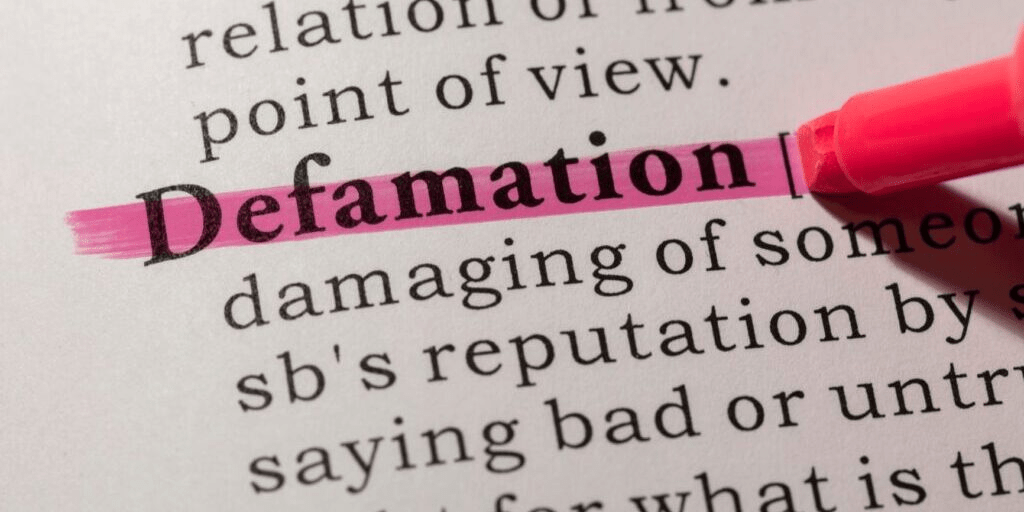
That brings us to defamation. Simply, to defame someone is to spread material that injures a person’s reputation without justification (Clift 2021). Defamation law in Australia gives a person whose reputation has been wrongfully injured the right to take legal action against any person responsible for the injury (Jager 2022c).
What can be considered defamatory?
The main criteria for material to be considered defamatory are:
- Any of the material shared must imply a meaning (or ‘imputation’) about a person that lowers the person’s reputation in the eyes of reasonable members of the community or causes the person to be ridiculed, avoided, or despised by members of the general public (Jager 2022c).
- The material must be communicated to a third party.
- The defamed person must be identifiable, but not necessarily named explicitly in the defamatory material
- As of 2021, the plaintiff must prove that the publication has caused, or is likely to cause, serious harm to their reputation.
So why do public figures sue for defamation so often?
It can be incredibly intimidating to receive a solicitor’s letter that threatens to sue you for defamation (Jager 2022b). Pasricha (2021) suggested that “The widespread promotion of these cases creates a culture where people are too scared to voice criticism, and high-profile figures can use the mere threat of a lawsuit to have unfavourable comments wiped from the Internet.” Often, public figures such as business leaders and celebrities will leverage defamation laws simply because they have the money to do it (Pasricha 2021).
In Karp’s (2021) article discussing how Australia has become the ‘Defamation nation’ Michael Bradley, the principal of Marque Lawyers, commented that the number of defamation cases in Australia has taken off in recent years, due in part to the level of publicity attained in high profile cases, and a perception that plaintiffs always come out on top. This doesn’t bode well for casual social media users, small-time journalists, and bloggers, as in the same article, activist Shane Bazzi mentioned “There is a huge power imbalance … And I am an unemployed activist … This could potentially bankrupt me.” This showcases how cautious public communicators must be when going against large public figures.
What can I use to defend myself?
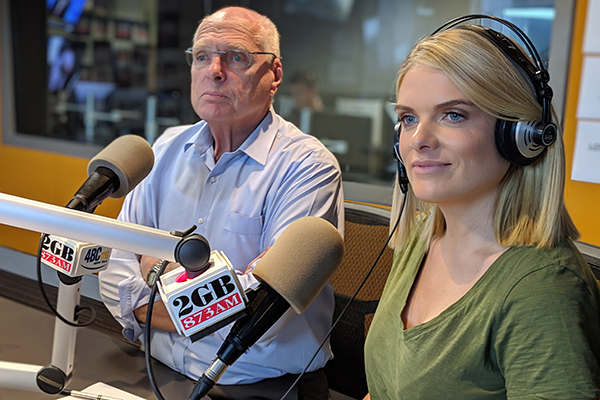
Multiple defences can be used in a defamation case by the defendant. Some defences include honest opinion, public interest, truth, and contextual truth. In one high-profile case, Erin Molan vs Daily Mail, the ‘contextual truth’ defence was used most successfully by the Daily Mail against Molan’s claim that the news source had defamed her.
The contextual truth defence allows the defendant to argue that even if some statements made in a publication were untrue, the publication itself conveys other defamatory meanings that are substantially true and therefore do no further harm to the plaintiff’s reputation than those that were untrue (Finch & Allen 2023).

The case began when The Daily Mail Australia published an article and two tweets where they portrayed Erin Molan as racist and an “arrogant woman of white privilege” due to her pronunciation of Polynesian names during a radio segment on the 2GB Continuous Call show. Molan took this matter to court, and in response to the claims, the Daily Mail denied that the article or tweets contained any defamatory meanings. Even if they did, the Daily Mail argued that the statements were largely true.
Initially in the trial, Justice Bromwich ruled in favour of Molan awarding her $150,000 in damages after he determined that the Daily Mail’s most serious imputation, that Molan was a racist, did not carry. However, this decision was appealed successfully by the Daily Mail after it was found that Justice Bromwich did not consider whether or not the Daily Mail’s second contextual imputation was different in substance because he had found that they failed to prove the substantial truth of the first contextual imputation. Eventually, it was mutually agreed that the case would be resolved after more than 2 years in court.
So yes, you are still entitled to your opinion, but…
It’s extremely important to make sure that as a journalist, blogger, or simply a user of social media, the information you’re publishing or sharing about a public figure is not slanderous or inaccurate. Even if it is unintentional, you have to be careful about what words or sources you are using to ensure accuracy in reporting.
Luckily, there are best practice guides and codes of practice available to communicators. For example, a code of conduct that is used in journalism is the Media Entertainment & Arts Alliance (MEAA) Journalist Code of Ethics, which provides extensive information on how to maintain journalistic integrity. More broadly, you can also find best practice guides for social media and online commentary from the Advertising Council Australia.

Therefore, given the nuances of Australia’s media laws, especially in defamation cases, it’s clear that public communicators must approach the internet with caution and ensure that their words are accurate and respectful to avoid any legal challenges.
References
Australian Human Rights Commission 2013, Freedom of information, Opinion and Expression, humanrights.gov.au.
Clift, B 2021, Why Defamation Suits in Australia Are so Ubiquitous — and Difficult to Defend for Media Organisations, The Conversation.
Finch, M & Allen, L 2023, Erin Molan and the beast of contextual truth, RCR Lawyers.
Jager, H 2022a, Defences to Defamation, Fitzroy Legal Service The Law Handbook.
― 2022b, If You Are Threatened with Legal Action for Defamation, Fitzroy Legal Service The Law Handbook.
― 2022c, What Is Defamation?, Fitzroy Legal Service Law Handbook.
Jones, M 1997, ‘Free Speech Revisited: The Implications of Lange & Levy’, Australian Journal of Human Rights, vol. 4, no. 1, pp. 188–205.
Karp, P 2021, Defamation nation: Why Are Australian Politicians so Quick to sue?, The Guardian.
Pasricha, S 2021, Important Question: Can You Call a Politician ‘Corrupt’ Without Being Sued for Defamation?, Zee Feed.
Shillito, J 2020, American Made: Why Does America Dominate in Media & Tech?, Linkedin.
Victorian Government Solicitor’s Office 2020, The Implied Constitutional Freedom of Political Communication, http://www.vgso.vic.gov.au.





 Lazy Pages
Leave a comment